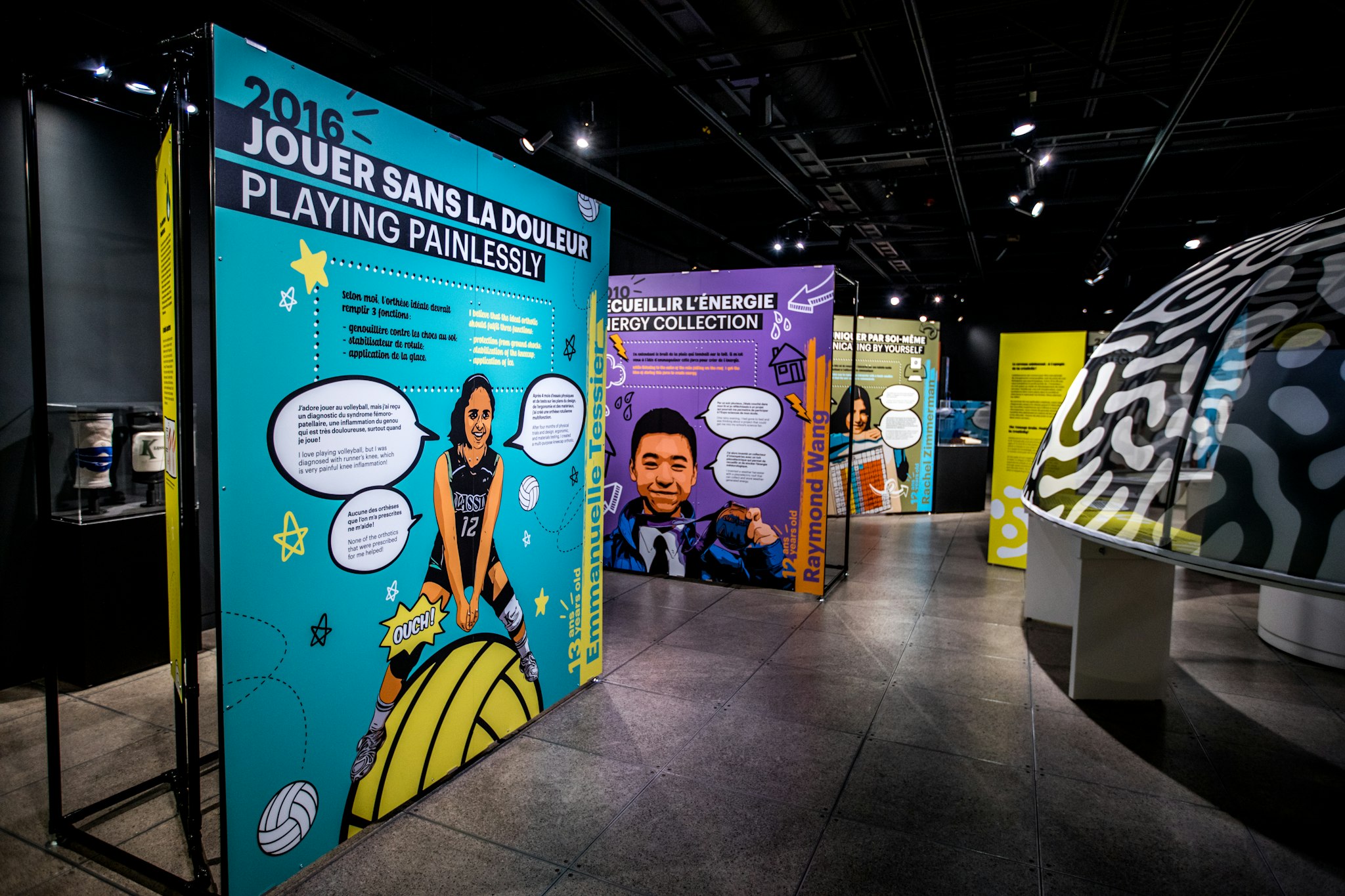
2022 was the 100th anniversary of Joseph-Armand Bombardier’s “first invention”. On New Year’s Eve 1922, when he was 15 years old, he tested his first true invention, a vehicle capable of driving on snow. One hundred years later, the Museum of Ingenuity J. Armand Bombardier (MIJAB) wants to celebrate this stroke of ingenuity. It also wants to highlight the creativity that inspired several young Canadians who put their own mark on history, as well as others who are paving the way of the future. One example is the Quebecer Jean Saint-Germain, who at 16 years old, invented the Playtex baby bottle, and Alexander Deans from Windsor, Ontario, who at 12 years old invented iAid, a device that allows blind people to navigate obstacles.
The exhibition is showcasing the difference between invention and innovation, one creating a new system or new procedure, the other corresponding to improving something already in existence. Bilingual and with a surface area of 1,300 to 2,000 ft2, it featurs inventors across time, old technologies to recent innovations, highlighting the stunning creative capacity of teenagers. It highlights the context that drives them to create, their determination, and the importance of believing in yourself and your ideas. The exhibit showcases their resourcefulness using a creative process.
In modules, the exhibition presents a collection of items while integrating images, video clips, and interactive devices. Supported by an educational program, it contributes to completing MIJAB’s mission, which is To keep the legacy of Joseph Armand Bombardier alive as a source of inspiration for future generations. Designed to reach a larger audience and meet the needs of school groups and families, its primary focus is teenagers.
This exhibition is a production of the Musée de l’ingéniosité J. Armand Bombardier in collaboration with the Sherbrooke University. This project was made possible thanks to the contribution of the Government of Canada.
Mission
Inspire, awaken and render accessible to everyone the discovery of nature, sciences and the richness of our collections from